
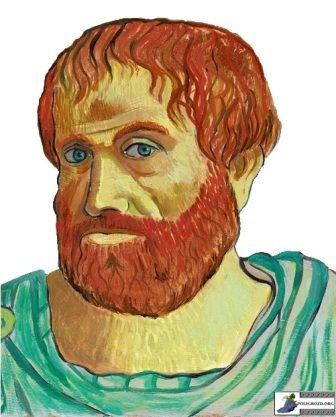
The son of a doctor, Aristotle was born in the city of Stagira in Macedonia in the year 384 BC, and was educated at Plato’s Academy. When his mentor Plato died in 347 BC, the Macedonian went home and became the tutor of Alexander, the son of King Philip of Macedon. His pupil, who later gained the suffix ‘the Great’, was rather fond of his teacher, and is supposed to have said, “I am indebted to my father for living, but to my teacher for living well.”
Aristotle stayed at the court of Alexander until 335 BC, when he founded his own academy, the Lyceum, in Athens. He remained in Athens until 323 BC, when anti-Macedonian sentiments forced him to leave. “I will not allow the Athenians to sin twice against philosophy” he said, with reference to the execution of Socrates, and fled to the island of Chalcis, where he died a year later, in 322 BC.
Reading Aristotle is easier than you might think. Even those who are not able to read him in the original Greek(firstly known as “Koine” language) cannot fail to be enamoured by his enthusiasm. A fascinating thing about Aristotle’s Politika (in English normally translated as The Politics), for example, is the way this enormously erudite man got carried away in his lectures. For instance, Aristotle simply could not help telling his students about a certain Hippodamus, the son of Eryphon. That Fifth Century BC Athenian was “the first man not engaged in politics to speak on the subject of the best Constitution.” According to Aristotle, this first philosopher of politics was “somewhat eccentric in his general mode of life owing to his desire for distinction… [he] lived fussily, with a quantity of hair and expensive ornaments and a quantity of cheap clothes – not only in winter but also in the summer” (The Politics II, 1268a).
This is perhaps a glimpse of how entertaining Aristotle could be when he lectured in his Lyceum – how he could spellbind his audience with seemingly irrelevant but highly entertaining anecdotes. But his aside about Hippodamus also suggests that Aristotle – the founder of psychology, political science, logic, poetics, physics, biology, and many other disciplines – had a childlike joy in telling his audience about all he knew. No wonder Cicero (106-43 BC), the Roman statesman and philosopher, noted that Aristotle’s writings were veniet flumen orationis aureum fundens – “like a pouring out of gold” (Academia Priora, Book II). And yet we don’t even have Aristotelian treatises: his only surviving books are lecture notes.

